Noobenheim News for Nerds
 Console Hardware
Contents
Let’s start with the big news. It’ll be globally released March 3rd, 2017 in Japan, US, Canada, major European countries, Hong Kong, and other territories. Two prices were released, being ¥29,980 in Japan and $299.99 in the US. Other prices have not yet been released, but the prices will probably be around that (Amazon.co.uk lists the price at £279.99). Included in the box are the actual console, both the left and right Joy-Cons, Joy-Con wrist strap, Joy-Con Grip, Switch dock, an HDMI cable, and the AC power adapter.
Nintendo will also be releasing world-wide Switch playing areas in various cities. Check their website for locations and times.
The biggest surprise came when Nintendo announced all games will be region-free. This is a major deviation from past Nintendo experiences where Japanese-exclusive games could not be played on US-purchased consoles. Finally we can import those exclusives and maybe Nintendo will gage the interest and possibly release the titles in more regions in the future.
Of course, the console has the three play styles:
- TV Mode where the Switch will connect to the dock and allow play on your TV. It’s the standard method when we think about console playing.
- Tabletop Mode where the Switch will stand on a table, desk, or any flat surface using its built-in kickstand. This will allow for multiplayer using the Joy-Con controllers.
- Handheld Mode where the Joy-Con controllers attach to the sides of the console, allowing an experience like TV Mode except on-the-go.
The battery life varies depending on the game being played, which makes a lot of sense. You wouldn’t imagine a game like Skyrim to use the same system resources as an Indie-developed game. Nintendo states the battery life should last between 2.5 – 6.5 hours. Nintendo’s website states The Legend of Zelda: Breath of the Wild can be played for roughly 3 hours before needing a charge.
The system charges using USB Type-C and will allow for portable charging using USB-certified batteries. Let’s hope the batteries we purchased for Pokémon GO are compatible with the system.
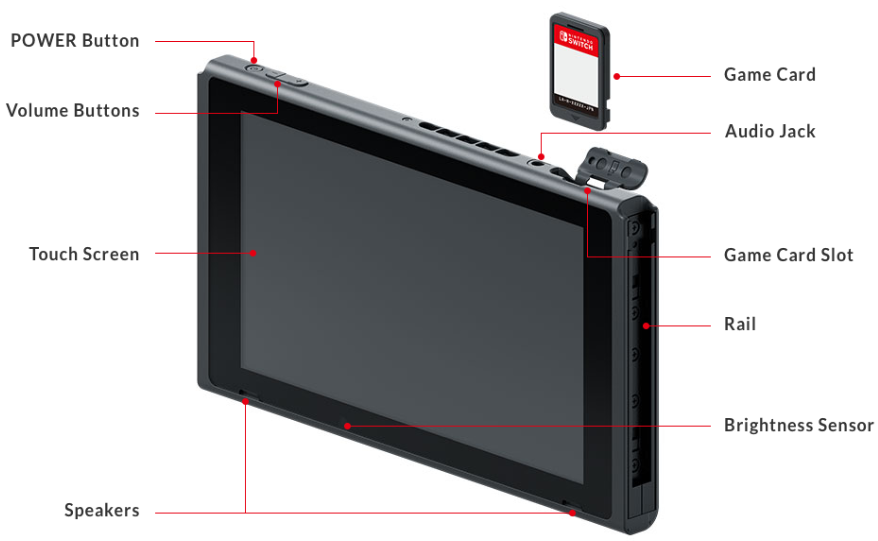 The system will have 32GB internal memory with the ability to expand storage using microSDXC cards. Nintendo has not yet revealed any limit of the expanded memory, however the New 3DS can expand up to 32GB. Hopefully the limit is lifted substantially on this new console. The console does revert back to cartridges instead of the disc formats we’ve come to know, which makes sense for any kind of mobile gaming unit.
The screen is a 6.2″ multi-touch capacitive touch screen with a resolution of 1280 x 720. The console contains a power button and volume buttons (I was hoping for a 3DS-type volume slider), an audio jack (even though I figured audio jacks were so last year thanks to Apple), dual speakers, and a brightness sensor.
The dock is a simple piece of hardware, with a single LED in the front to indicate if it’s outputting to the TV, and two USB 2.0 ports. The back (internally, as it has a back cover) only has an AC adapter, HDMI, and a single USB port (no indications on which, however it does have the 3.0 blue color). No Ethernet jack is visible, so hopefully there will be an adapter or will continue the trend of using the Wii’s Ethernet adapter. Surprisingly, as simple as this device seems, if you’d like to purchase an additional dock for other TVs in the house, it’ll cost $89.99 MSRP for the dock, power cable, and HDMI cable. Yikes.